


In the vastness of the cosmos, where stars speckle the night sky, the hunt for exoplanets—worlds orbiting stars beyond our Sun—has reached a thrilling new chapter.
As of September 2025, astronomers have confirmed 5,983 exoplanets across 4,470 planetary systems, according to the NASA Exoplanet Archive.
Behind this staggering tally lies an unsung hero: artificial intelligence.
AI is transforming the search for alien worlds, sifting through torrents of telescope data to spot planets that might otherwise elude us.
From pinpointing Earth-like candidates to analyzing distant atmospheres, here’s how AI is reshaping our cosmic quest—and bringing us closer to answering whether we’re alone in the universe.
AI’s Role: A Stellar Data Detective
Imagine trying to find a single whisper in a roaring crowd.
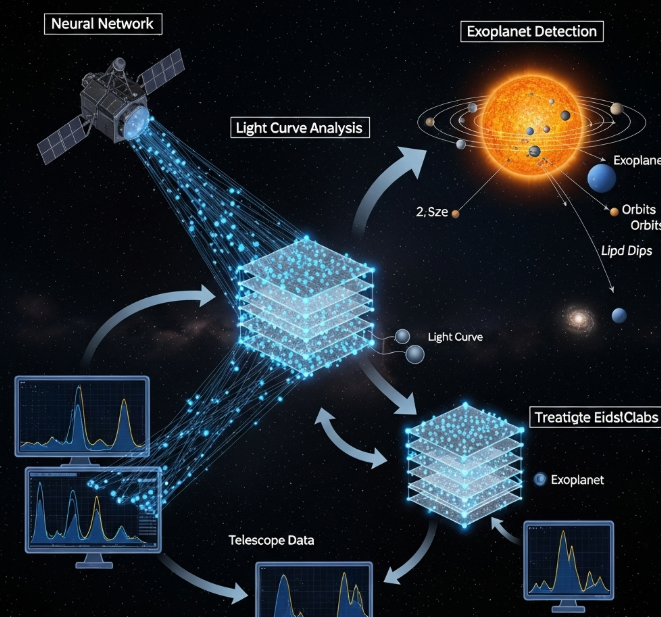
That’s the challenge astronomers face when scouring light curves—graphs of a star’s brightness over time—for the faint dips caused by a planet’s transit.
AI, particularly machine learning, excels at this.
Algorithms like convolutional neural networks (CNNs) are trained to distinguish planetary signals from cosmic noise, drastically speeding up discoveries.
A 2018 study in The Astronomical Journal demonstrated this power when Google’s AI team used a neural network to analyze Kepler data, identifying two new planets (Kepler-90i and Kepler-80g) in systems previously thought to be fully mapped.
This approach has only grown more sophisticated.
In 2025, AI models are routinely applied to data from NASA’s Transiting Exoplanet Survey Satellite (TESS), which has cataloged thousands of candidates since its 2018 launch.
By automating the vetting process, AI reduces false positives—mistaking stellar flickers for planets—allowing astronomers to focus on the most promising targets for follow-up with the James Webb Space Telescope (JWST).
Real Discoveries Powered by AI
AI’s impact shines in recent finds.
In 2023, a machine-learning algorithm reanalyzed Kepler data, confirming TOI-700 d, a potentially habitable Earth-sized planet in the Goldilocks zone of its star, 101 light-years away.
This discovery, validated with AI’s help, marked a milestone for TESS, highlighting its ability to uncover worlds where liquid water might exist.
Another gem is K2-18b, a sub-Neptune 124 light-years away, where JWST’s 2023 observations, aided by AI-driven spectral analysis, detected water vapor, methane, and possible dimethyl sulfide—a molecule linked to biological processes.
While not definitive proof of life, AI’s role in processing these complex atmospheric signals has fueled excitement about K2-18b’s potential.
In 2025, AI continues to shine.
A study in Nature Astronomy reported a neural network that improved the detection of small, rocky planets in TESS data, contributing to the confirmation of 65 new exoplanets added to the NASA Exoplanet Archive in March 2022—a pace that has continued.
These include systems like TOI-1346, where AI helped identify two planets via transit signals.
The Future: AI and the Search for Life
AI isn’t just finding planets; it’s probing their habitability.
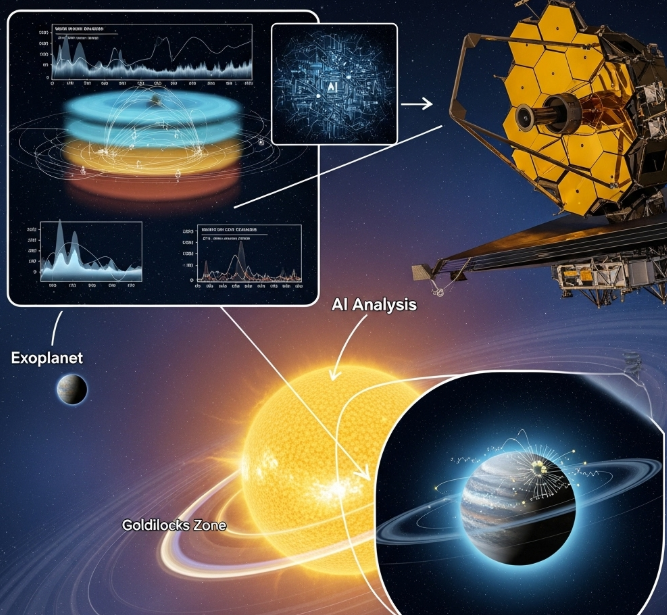
Machine learning models now predict atmospheric compositions, using data from JWST to model light scattering and identify gases like carbon dioxide or oxygen.
A 2024 study from Ludwig Maximilian University showcased physics-informed neural networks (PINNs) that enhance our understanding of exoplanet clouds, crucial for spotting biosignatures.
With the upcoming PLATO mission (set for 2026), AI will analyze thousands of stars, potentially doubling the exoplanet count.
The SETI Institute is also leveraging AI to refine searches for technosignatures—signals of alien technology—merging exoplanet hunts with the quest for intelligent life.
As AI sharpens our cosmic lens, each discovery brings us closer to a profound truth: our galaxy may be brimming with worlds, some perhaps not so different from our own.
The next Earth could be just a dataset away, and AI is leading the charge.

Sources
- NASA Exoplanet Science Institute (2025). 2025 Exoplanet Archive News.
- Christiansen, Jessie et al. (2013). The NASA Exoplanet Archive: Data and Tools for Exoplanet Research.
- Shallue, Christopher J. & Vanderburg, Andrew (2018). Identifying Exoplanets with Deep Learning: A Five-planet Resonant Chain around Kepler-80 and an Eighth Planet around Kepler-90.
- NASA Exoplanet Archive (2025). Exoplanet Catalog.
- Wiki Contributors (2025). Exoplanet.
- Howell, Elizabeth (2023). NASA’s TESS Discovers Planetary System’s Second Earth-Size World.
- Ludwig Maximilian University of Munich (2024). Astrophysics: AI Shines a New Light on Exoplanets.
- NASA Exoplanet Exploration Program (2025). ExoPAG News and Announcements - Archive 2025.