


Ocean waves are a fascinating natural phenomenon primarily driven by the interaction of wind, water, and other environmental factors.
Below is a detailed explanation of why waves form, based on accurate scientific information.

1. Wind as the Primary Driver
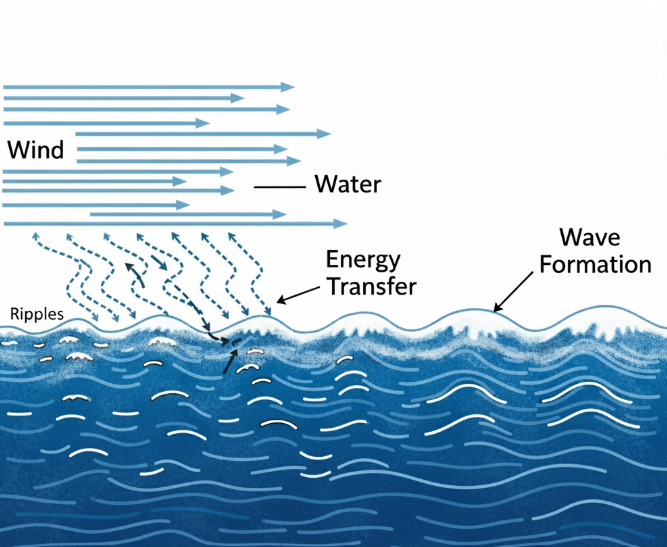
Waves are predominantly generated by wind blowing across the surface of the ocean.
When wind moves over the water, it transfers energy to the water's surface through friction.
This energy causes the water to move, creating ripples that can develop into larger waves.
The size, speed, and duration of the wind, as well as the distance over which it blows (known as the "fetch"), determine the size and strength of the waves.
Stronger winds blowing over a longer distance for an extended period produce larger waves.
2. Types of Waves
Waves can be categorized based on their formation and behavior.
- Wind Waves: These are the most common waves, formed by local winds. Their size depends on wind speed, duration, and fetch.
- Swell Waves: These are waves that have traveled far from their point of origin, becoming more regular and organized. Swells are often seen as smooth, rolling waves.
- Tsunami Waves: Caused by underwater disturbances such as earthquakes, volcanic eruptions, or landslides, tsunamis are not related to wind but to sudden displacements of water.
- Tidal Waves: These are caused by the gravitational pull of the moon and sun, though they are not true waves but rather predictable changes in sea level.

3. Other Contributing Factors
While wind is the primary cause, other factors can influence wave formation
- Gravitational Forces: The gravitational pull of the moon and sun affects tides, which can influence wave patterns indirectly.
- Coriolis Effect: The Earth's rotation influences ocean currents and wave patterns, particularly in large-scale swells.
- Seafloor Topography: The shape and depth of the ocean floor can amplify or reduce wave size as waves approach the shore. For example, shallow areas can cause waves to "break" as they slow down and rise.
- Atmospheric Pressure: Low-pressure systems, such as those in storms or hurricanes, can enhance wave formation by increasing wind speeds and creating storm surges.

4. Wave Dynamics
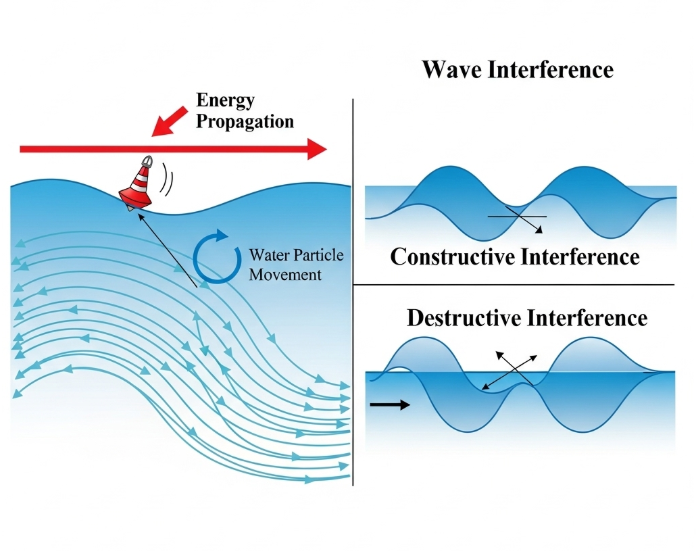
Once formed, waves propagate through the ocean, carrying energy rather than water itself.
The water particles in a wave move in a circular motion, returning to their original position after the wave passes.
This is why objects floating on the surface bob up and down rather than being carried along.
Waves can also interact with each other, leading to phenomena like constructive interference (where waves combine to form larger waves) or destructive interference (where waves cancel each other out).
5. Human and Environmental Relevance
Understanding wave formation is crucial for various applications, including maritime navigation, coastal engineering, and predicting natural disasters like tsunamis.
Waves also play a significant role in coastal ecosystems, influencing sediment transport and shaping shorelines.
Sources
- Bascom, W. (1980), Waves and Beaches: The Dynamics of the Ocean Surface
- Holthuijsen, L. H. (2007), Waves in Oceanic and Coastal Waters
- Kinsman, B. (1984), Wind Waves: Their Generation and Propagation on the Ocean Surface